Tempest
Connector Category: API Feed Source
Notice
This integration is available in Intel Exchange from v3.7.6.1 onwards.
About Integration
Configure Tempest as an API feed source in Intel Exchange to retrieve threat intelligence reports as indicators, including hashes, URLs, IPs, and domains. This integration enhances visibility by delivering monitoring and investigation reports from Tempest, enabling you to track threat activity, support investigations, and use indicators effectively within Intel Exchange.
In Intel Exchange, the Tempest integration retrieves the following types of threat data objects:
Reports
Indicators of Compromise (IOCs)
Use Cases
Access monitoring and investigation reports from Tempest to understand ongoing and emerging threat activity.
Use Tempest indicators such as hashes, URLs, IPs, and domains to enrich investigations and existing intelligence in Intel Exchange.
Support threat analysis by correlating Tempest reports with internal data and other intelligence sources.
Share relevant Tempest reports and indicators across teams to improve situational awareness and response coordination.
Configure Tempest
Integrate with Tempest as a feed source and start receiving threat intel in Intel Exchange. You can use the following sections for more information:
Configure Tempest as a Feed Source
Configure Tempest as an API feed source in Intel Exchange to retrieve reports, and IOCs from Tempest.
Before you Start
You must have the View API Feed, View Feed Source, Create Feed Source, and Update Feed Source permissions in Intel Exchange.
You must have the base URL and API key of your Tempest account.
Steps
To configure Tempest as an API feed source in Intel Exchange, follow these steps:
Go to Administration > Integration Management. In FEED SOURCES, click APIs.
Click Add API Source.
Search and select Tempest.
Click Add Instance and enter the following details:
Instance Name: Enter a unique name to identify the instance. For example, Prod-Tempest.
Base URL: Enter the base URL of your Tempest instance. The default base URL is
https://api.tempest.center/rest.API token: Enter the API token to authenticate with Tempest.
Verify SSL: Select this to verify the SSL certificate and secure the connection between the Intel Exchange and Tempest servers. By default, verification is enabled.
Note
Enabling SSL verification is recommended. If you disable this option, it may result in the use of an expired SSL certificate while configuring the instance. This may not establish the connection properly, and you will not be notified in case of a broken or improper connection.
Click Save.
After the Tempest is configured successfully, you can view the feed channels. You can configure multiple instances by clicking Manage > Add More.
Configure Tempest Feed Channels
Configure the feed channels to retrieve threat data from Tempest and store them in collections within Intel Exchange.
Steps
To configure the feed channels, follow these steps:
Go to Administration > Integration Management. In FEED SOURCES, click APIs.
Search and select Tempest.
Click the vertical ellipsis and select Manage.
Click Manage Feed Channels.
Select a feed channel and turn on the toggle. Use the following information while configuring the channel:
Start Date and Time: Enter the date and time to start polling feeds. Select a date within 15 days from the current date.
Note
This field is not applicable to the Retrieve Investigation Reports feed channel. This channel does not support date-based filtering, and polling always retrieves the latest available data.
Collection Name: Enter the name of the collection to group the feed data. For example, Tempest Feeds. Intel Exchange created the collection and stores all the feeds from the feed channel.
Polling Cron Schedule: Select from one of the following Polling Cron Schedule types to define when to poll the data:
Manual: Allows you to manually poll from the source collection.
Auto: Allows you to automatically poll for threat intel from sources at specific time intervals. The default polling cron schedule is Auto. Enter a frequency in minutes between 240 and 21600 minutes in Polling Time. The default polling time is 1440 minutes.
TLP: Set the TLP for the feeds that do not have a TLP already assigned. The default TLP is Amber. Alternatively, you can select None to ensure that no TLP is assigned to the feeds.
Default Source Confidence: Enter the confidence score for the feeds that do not have a confidence score already assigned. The default confidence score is 100.
Deprecates after: Specify the number of days after which the threat data (indicator) will be marked as deprecated, unless the source defines its own expiry duration. The allowed range is 1-180 days.
Custom Score: Select the Relevance and Severity Score for the channel.
Default Tags: Select any tags to identify and categorize the feeds.
Click Save.
The feed channel is configured, and you can poll feeds from the channel. You can enable the other feed channels and poll feeds, and view the feeds.
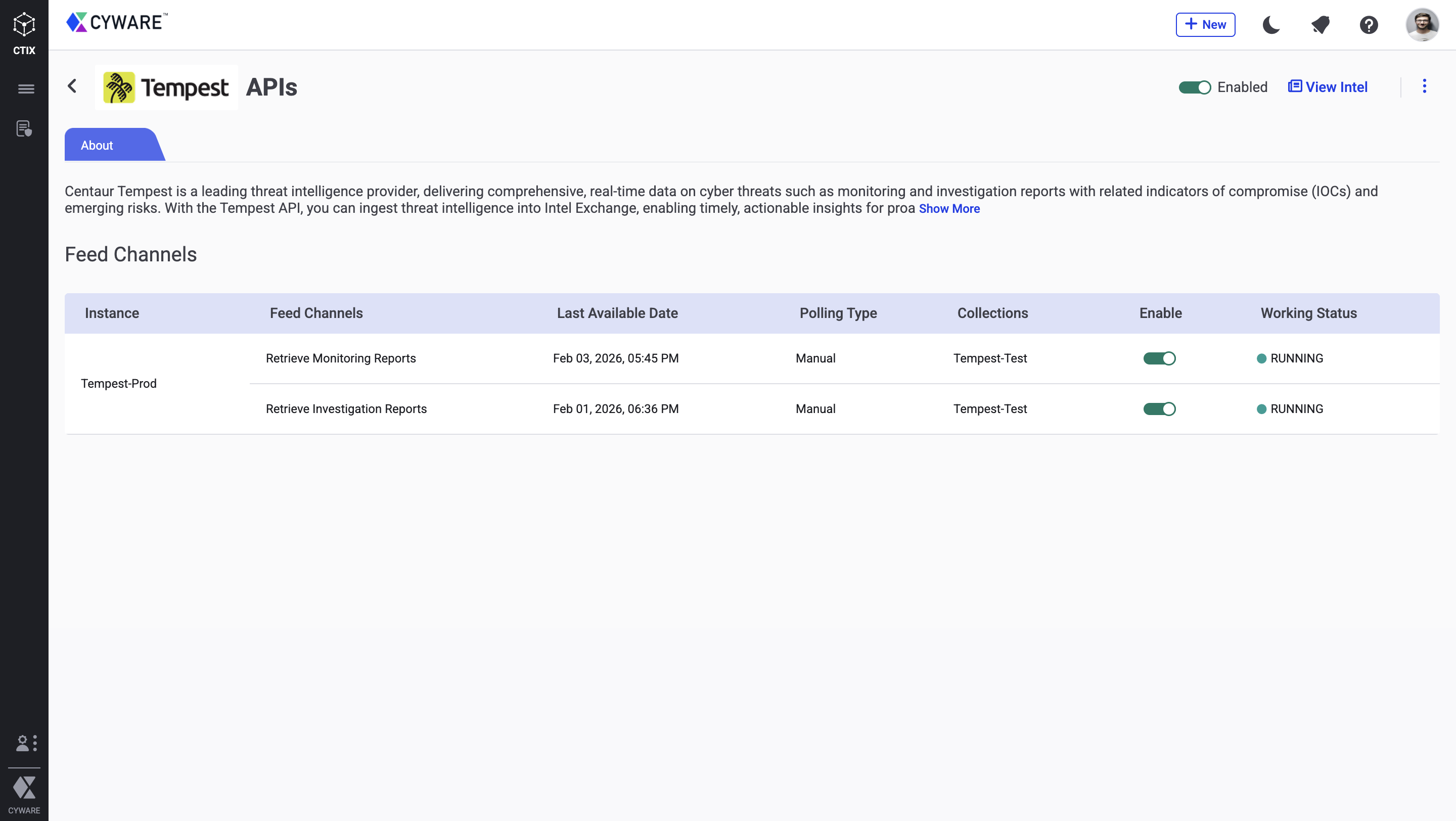
Test Feed Channel Connectivity
Test the connectivity of the Tempest API feed channels to ensure that the connection with the correct API endpoint is established and that you have permission to poll feeds.
Before you Start
Ensure that the Tempest API feed source is enabled.
Ensure that the feed channel for which you want to test connectivity is enabled.
Steps
To test the connectivity of a feed channel, follow these steps:
Go to Administration > Integration Management. In FEED SOURCES, click APIs.
Search and select the Tempest app.
On a feed channel, click the vertical ellipsis and select View Details.
In the Working Status section, click Test Connectivity.
If the connection is established, then the working status shows Running. If the connectivity is broken, then the working status shows a Connection Error. Hover over the tooltip next to Connection Error to view the error code.
Note
When a feed channel loses connectivity, it is automatically disabled, and the system attempts to restore connectivity three times every hour. If the connectivity is successfully restored, the feed channel is automatically re-enabled.
To understand the error code and troubleshoot broken connectivity, see Troubleshoot Integrations.
Tempest Feed Channels
The following table lists the feed channel and the API endpoint used to retrieve feeds from Tempest:
Feed Channel | API Endpoint |
|---|---|
Retrieve Monitoring Reports |
|
Retrieve Investigation Reports |
|